
Lizon Delomosne
awarded the prize for the Best Poster
During the 6th edition of VCWAP, early-career women researchers presented 43 posters on ©GatherTown, an interactive platform that fosters real-time discussions. Among this great lineup, Lizon Delomosne’s work stood out, earning the Best Poster Award. She was awarded a €100 prize, generously provided by AWAP. Congratulations, Lizon, on this well-deserved recognition!
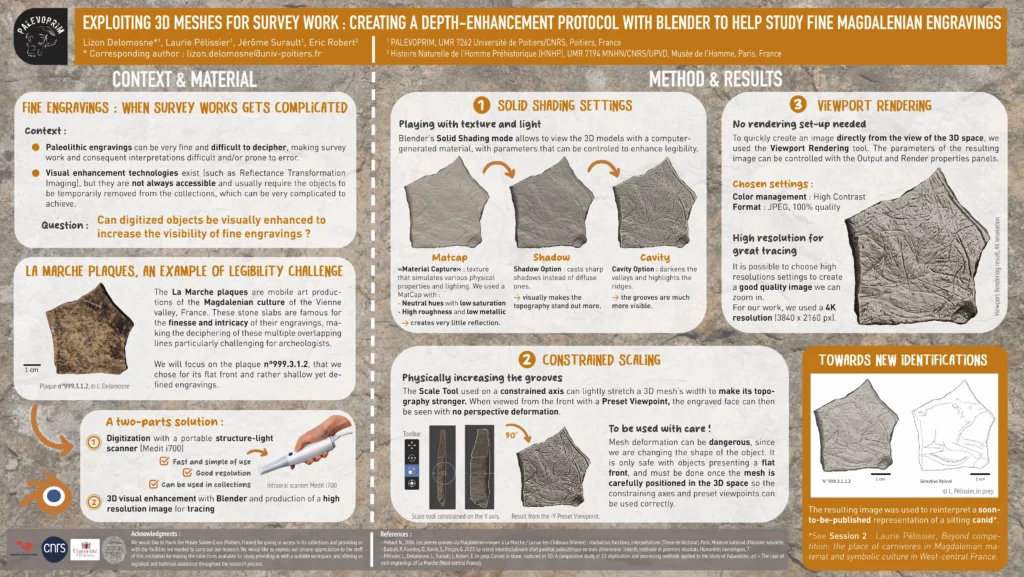
About the poster: ‘Exploiting 3D meshes for artistic survey: creating a depth-enhancement protocol to help study fine Paleolithic engravings’ by Lizon Delomosne, Laurie Pélissier, Jérôme Surault & Eric Robert
Lizon Delomosne works on improving the visibility and interpretation of fine engravings in Paleolithic art through 3D digitization. Focusing on lithic slabs from the Magdalenian site of La Marche (France), her study explores whether 3D meshes can enhance barely visible incisions that are difficult to capture through photography. Using a structured-light scanner and the software Blender, she develops a simple and efficient protocol combining lighting, material rendering, and mesh deformation to highlight fine grooves. The results show that these techniques significantly improve readability and offer a practical and accessible tool for archaeologists studying complex engraved surfaces.
Meet Lizon Delomosne
Lizon Delomosne is an assistant engineer at PALEVOPRIM (Université de Poitiers and CNRS), specialized in 3D Imaging. The work consists in exploiting the possibilities of 3D digitization and modeling for the study, transmission and valorisation of cultural and natural heritage.
Originally trained in archaeology and art history at the Ecole du Louvre (Paris) with a specialization in South and South-East Asian arts, she discovered 3D Imaging while working on her Master Degree. She participated in the Study and Conservation-Restoration Project of the Dancing Shiva of Koh Ker (Cambodia) with the Ecole Française d’Extrême-Orient, realizing the full scanning and digital reconstruction of the fragmentary statue piece by piece.
To complete her technical training, she then pursued a Professional Degree in Digital Work at Cergy Paris University, and became an imaging trainee at PALEVOPRIM.
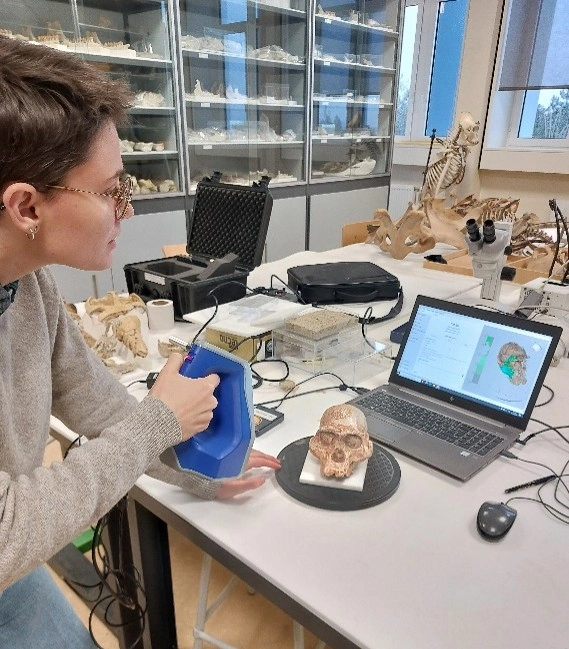
Since then, she has been working on various projects with the lab: 3D digitization missions, assembly of models and paleoartistic reconstructions of extinct animals, creation of visuals for publication, videos and 3D printing for mediation and valorization …
Currently, she is part of the LHOSA (Looking for Human Origins in South Africa) Project as a 3D data manager and collector.